Tag: English

Small Scale Incinerator for Solid Waste

Basic Info.

Model NO.:smokeless crematorium
Pullution Sources:Solid Waste Processing
Processing Methods:Combustion
Export Markets:Global

Product Description

Items Specification
Model TS10(PLC) / TS20(PLC) / TS30(PLC) / TS50(PLC) / TS100(PLC)
Main Product List Double Combustion Chamber
Smoke Filter Chamber
PLC Mode Control Case
Stainless Steel Chimney
Italy oil/gas burner: 02 units
Oil Tank (if oil fuel)

Pets Crematorium

Basic Info.

Style:Crematorium
Material:Crematorium
Species:Dog
Export Markets:Global

Additional Info.

Trademark:CLOVER
Origin:Nanjing Clover

Product Description

The required circular Medical Waste Incinerator is going to be quoted according to Technical Specifications provided below:  1) A self-contained, gas gas, medical waste incinerator with a minimum burn speed capacity of 100 kg/day. 

2) A medical waste incinerator shall be specifically designed from the manufacturer to dispose of all Bio-Hazard medical wastes. 

3) At a minimum the unit shall be sized to incinerate 2.0 kg/exam-room/24-hrs when being worked continuously for 12 hours every day, however no less than 100kg/day total. 

4) The Incinerator shall be batch fed. 

5) The incinerator gas tank shall meet the following requirements:  A) The tank shall be installed above ground and according to each one the big medical waste incinerator, big portable incinerator, big scale animal incinerator, big scale incinerators for medical waste disposal, fuel tank requirements in Section 1015 including secondary containment.  B) The tank shall be sized to hold a 14 day supply of diesel fuel 

6) Manufacturer has to supply the following capacity calculations and all supporting information for your incinerator: 

– The daily waste flow rate (kg/day or lbs/day)  Minimum incinerator burn rate capacities  – Minimum cure period for your refractory to protect against breaking into the refractory  A comprehensive list of the maintenance components A minimum of 500 pounds of refractory for repairs  A minimum of 1 gallon of hydraulic oil 

7) The contractor shall provide 3 pricing options:  Option 1: To Quotation just for the Full System  Option 2: To Estimate the price of Entire System, as well as the Installation  Option 3: To give training to appropriate relevant staff according to this ‘Operations and Maintenance. (Afghanistan)

Items/Model TS10(PLC) TS20(PLC) TS30(PLC) TS50(PLC) TS100(PLC)
Burn Rate 10 kg/hour 20 kg/hour 30 kg/hour 50 kg/hour 100 kg/hour
Feed Capacity 20kg 40kg 60kg 100kg 200 kg
Control Mode PLC PLC PLC PLC PLC
Combustion Chamber 100L 210L 330L 560L 1200L
Internal Dimensions 50x50x40cm 65x65x50cm 75x75x60cm 100x80x70cm 120x100x100cm
Secondary Chamber 50L 110L 180L 280L 600L
Smoke Filter Chamber Yes Yes Yes Yes Yes
Feed Mode Manual Manual Manual Manual Manual
Voltage 220V 220V 220V 220V 220V
Power 0.5Kw 0.5Kw 0.5Kw 0.7Kw 0.7Kw
Oil Consumption (kg/hour) 5.4–12.6 7.8–16.3 10.2–20 12.1–24 14–28
Gas Consumption (m3/hour) 6.2–11.4 8–15.7 9.8–20 9.9–26.1 10–32.2
Temperature Monitor Yes Yes Yes Yes Yes
Temperature Protection Yes Yes Yes Yes Yes
Oil Tank 100L 100L 100L 100L 200L
Feed Door 30x30cm 45x40cm 55x50cm 70x55cm 80x60cm
Chimney 3Meter 3Meter 5Meter 5Meter 10Meter
Chimney Type Stainless Steel Stainless Steel Stainless Steel Stainless Steel Stainless Steel
1st. Chamber Temperature 800degree–1000degree 800degree–1000degree 800degree–1000degree 800degree–1000degree 800degree–1000degree
2nd. Chamber Temperature 800degree–1000degree 800degree–1000degree 800degree–1000degree 800degree–1000degree 800degree–1000degree
Residency Time 2.0 Sec. 2.0 Sec. 2.0 Sec. 2.0 Sec. 2.0 Sec.
Gross Weight 1500kg 2200kg 3000kg 4500kg 6000kg
External Dimensions 140x90x120cm 160x110x130cm 175x120x140cm 230x130x155cm 260x150x180cm

Medical Waste Incinerator Diesel and Gas Specification

Basic Info.

Model NO.:medical solid waste incinerator 100kg
Export Markets:Global

Product Description

Key Features:  * All versions with Dual combustion room.  * Stainless Steel chimney/stack, long life. *according to sequence * High fever, long life of incinerator.  * Free or minimum installation on site.  * High burn rate, from 10kgs to 500kgs per hour, up to 6ton daily.  * PLC Control Plane. *according to order  New Design for pet animal cremation business.  * One year warranty on incinerator and parts in stock. 

Program Scope:  1. Hospital& clinic: Iatric Waste, Infectious Waste, Dressing, Bio-Waste, Medicine.  2. Slaughter House &Pet Hospital &Farm: Dead Animal, Bio-Waste.  3. Laboratories, Remote Locations, Disaster Relief Operations, Animal Cremation  Company License No.,: 320105000138343

Items Specification
Model TS10(PLC) / TS20(PLC) / TS30(PLC) / TS50(PLC) / TS100(PLC)
Burn Rate 10 kg/hour 20 kg/hour 30 kg/hour 50 kg/hour 100 kg/hour
Main Product List Double Combustion Chamber
Smoke Filter Chamber
PLC Mode Control Case
Stainless Steel Chimney
Italy oil/gas burner: 02 units
Oil Tank (if oil fuel)

Incinerator Medical Waste Maximum Capacity

Basic Info.


Model NO.:medical waste incinerator manufacturers
Export Markets:Global

Product Description


Nanjing Clover Medical Technology Co., Ltd. is a leading waste incinerator manufacturer in China.

Key Features:  * All versions with Dual combustion room.  * Stainless Steel chimney/stack, long life. *based on order  * High fever, long life of incinerator.  * Free or minimal installation on site.  * High speed rate, from 10kgs to 500kgs per hourto 6ton per day.  *based on order  * New Design for pet animal cremation business.  * One year guarantee on incinerator and parts in stock. 

Items/Model YD-10C YD-20C YD-30C YD-50C
Burning Rate (kgs/Hour) 10 kgs/Hr. 20 kgs/Hr. 30 kgs/Hr. 50 kgs/Hr.
Feed Capacity (kgs) 40 kgs 40 kgs 50 kgs 80 kgs
Equipment Weight 1200 kgs 1200 kgs 1800 kgs 2200 kgs
Picture  
Primary Chamber (Liters) 200 200 250 400
Secondary Chamber (Liters) 140 140 140 140
External Dimensions (cm) 170x140x160 170x140x160 170x140x190 180x160x200
Internal Dimensions (cm) 55x55x65 55x55x65 55x55x85 70x70x85
Oil Tank(Liters) 50 100 100 150
Door Opening (cm) 38 x 48 38 x 48 38 x 48 45×55
Chimney (M) 5 5 5 5
Chimney Type Stainless Steel Stainless Steel Stainless Steel Stainless Steel
Secondary Chamber  YES YES YES YES
Mix-Combustion Chamber YES YES YES YES
Smoke Filter Chamber YES YES YES YES
Combustion Fuel Oil/Gas Oil/Gas Oil/Gas Oil/Gas
Residency Time 2.0 Sec. 2.0 Sec. 2.0 Sec. 2.0 Sec.
Temperature Monitoring YES YES YES YES

Program Scope:  1. Hospital& practice: Iatric Waste, Infectious Waste, Dressing, Bio-Waste, Medicine.  2. Slaughter House &Pet Hospital &Farm: Dead Animal, Bio-Waste.  3. Laboratories, Remote Locations, Disaster Relief Operations, Animal Cremation

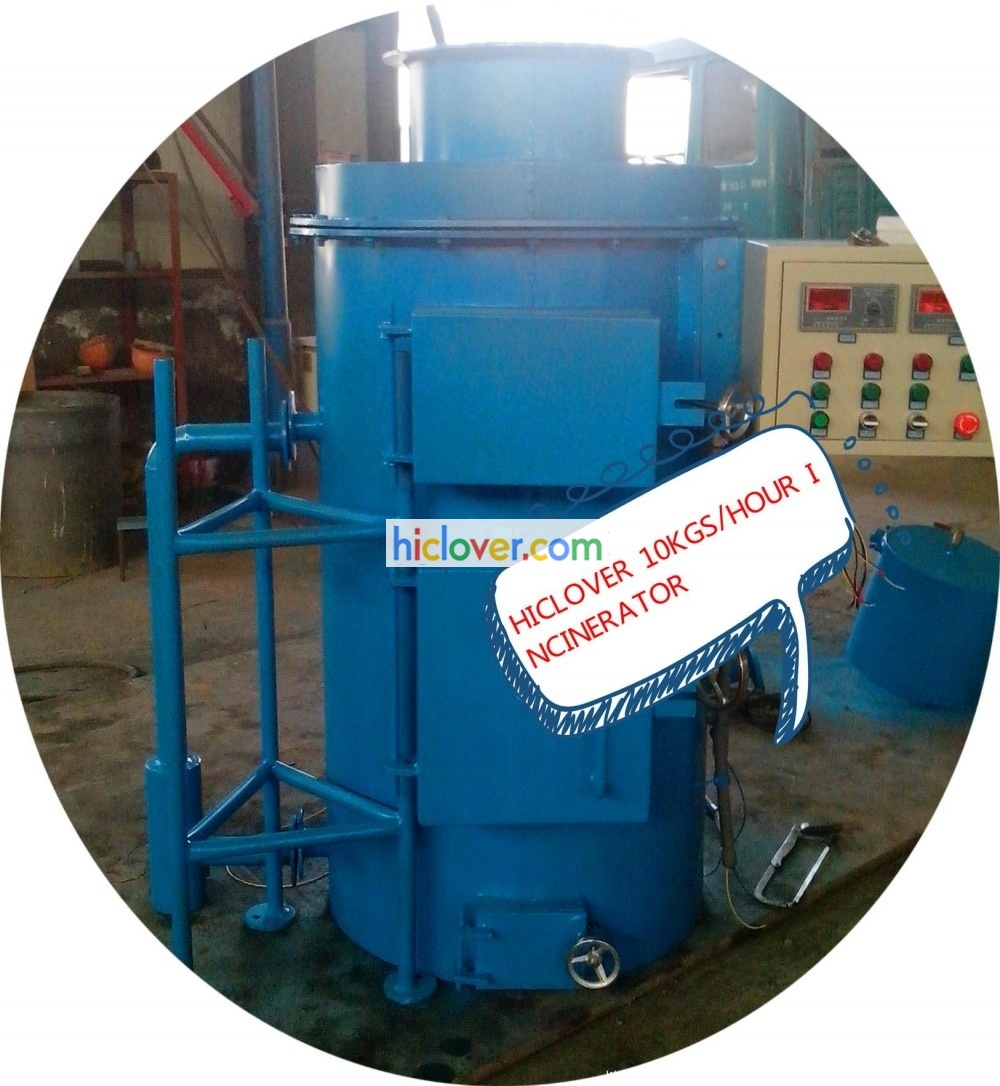
hiclover 10kgs per hour incinerator

Smallest waste incinerator for small hospital 
average 10kgs per hour. 
with double(2) sets burner.

Equipment Technical Specifications

Model

YD-10

Feed Capacity

Typical 20 kgs per feed

Burning Rate

Typical 10 kgs Each hour

Burning Time Each Feed

2 hours

Voltage

220V

Fuel

Diesel Petroleum

Burner

Italy Burner

Feed Mode

Manual

Fuel consumption (Oil)

5.4-12.6 Kgs/Hour

External Dimensions

100 x 100 x 160cm (mainbody)

Internal Dimensions

50 x 50 x 80cm(Main Chamber)

Waste combustion chamber

200Liters

Article Combustion Chamber

100Liters

Oil Tank Capacity

50 Liters

Door Opening

35 x 35cm

Chimney

3.0M

Gross Weight

1000kgs

Chamber Material

Refractory Concrete

Max.

126,000Kcal/Hr.

Operation Technical Specifications

Chamber fever

Chamber Anti-Rate

8000C -10000C

Residency time

13500C

0.5 Sec.

Burning efficiency

>98%

Waste Lower Calorific Power

HICLOVER – Medical Environmental 

3000Kcal


Waste Incinerators
Medical Waste Incinerator
Pet Animal Cremation
Solid Waste Incinerator

Tel:  +86-25-8461 0201   
Mobile: +86-13813931455(whatsapp/wechat)
Website: www.hiclover.com  
Email: [email protected]
Email: [email protected]  
Nanjing Clover Medical Technology Co.,Ltd.


Baltimore teens take out the Garbage

Youth battle a waste incinerator.

It is the threat of dangerous air pollution that has pupils at Curtis Bay’s Benjamin Franklin High School leaving the classroom and showing in the streets of Baltimore.

In Curtis Bay, a neglected waterfront neighborhood in the northwestern fringes of Baltimore, an alliance of environmental activists and local groups–such as an energetic and inventive group of high school students–has succeeded in holding off the construction of an great trash incinerator project.

The pupils wowed members of the Baltimore Board of Education this May with a demonstration that mixed closely researched public and environmental health evaluation with a hip-hop pattern that’d board members around their feet. Greg Sawtell, a secretary with Baltimore-based United Workers (among many organizations allied against the incinerator), says conversations with faculty board members because have left him optimistic that they will oppose the project.

although planning work on the incinerator started last year, full-scale construction is postponed, and the projected completion date has been pushed to 2016 from a first estimate of 2013. Opponents are reluctant to claim sole credit for the delays, as there also have been financing and regulatory problems, but believe their efforts are sharpening scrutiny and slowing progress.

Discuss of the so-called trash-to-energy incinerator plant started some five years back, after chemical manufacturer FMC Corp closed a pesticide plant, eliminating 130 jobs (such as 71 union jobs with the United Steelworkers) and leaving empty a sizable parcel of property zoned for heavy industry. The website straddles the Curtis Bay and Fairfield areas of the city, elements of which have large African inhabitants. To many political and community leaders in this deindustrialized and job-starved part of the city–which is located far from the famed Inner Harbor or Fells Point entertainment districts–it seemed like a boon when Energy Answers Inc., an Albany, New York-based power development company, appeared on the scene to propose a plant that would burn construction and commercial waste to produce electricity. Energy Answers billed the plant as a means to restore up to 200 occupations and supply clean, low-cost energy.

Initially, Energy Answers fought to find loans and missed a deadline to procure national stimulus money. However, in May 2011, the project got a big boost when O’Malley signed legislation to help make the plant profitable through a complicated pollution credits scheme that would funnel money to Energy Answers for producing so-called clean electricity. (A couple of days after, Energy Answers gave $100,000 in campaign contributions to the Democratic Governors Association, chaired by O’Malley.)

However, for locals, the bloom was already coming from the rose. It had emerged that an estimated 400 to 600 exhaust-spewing trucks carrying waste tires, plastics, plastics and construction materials would travel throughout the roads of Curtis Bay every day to feed the plant. The incinerator itself will burn up to 4,000 tons of waste each day for a long time — increasing more erratic public health issues. In a recent Baltimore Sun op-ed urging cancellation of the project, Gwen DuBois, of Chesapeake Physicians for Social Responsibility, said the plant can emit dioxin, mercury and other heavy metals, which can cause cancer and other ailments.

“What a lot of people don’t realize is just how filthy these plants actually are,” says Mike Ewall, founder and co-director of Energy Justice Network, a nationwide organization devoted to assisting communities fight dirty energy development. “They are much worse than coal or anything else. And this would be the biggest such plant in the country.” Curtis Bay is already the very polluted zip code in Maryland, Ewall notes, including that low-income areas of color are often used as dumping grounds just because they lack the political power to fight back.

It is the threat of dangerous air pollution which has pupils at Curtis Bay’s Benjamin Franklin High School leaving the classroom and demonstrating in the streets of Baltimore. In their biggest action, in late 2013, over 100 protesters marched from the school to the website of their proposed incinerator–just a mile off. A connected petition has garnered over 2,000 signatures.

Recent Benjamin Franklin graduate Audrey Rozier is a leader of Free Your Voice, the pupil group intends to block the incinerator, in addition to the co-author of a vampire song devoted to the effort. “We’ve got our rights according to the changes / But do we feel like we have been resented / Ignored, pushed to the side by which opinions don’t matter,” goes one verse.

Rozier says that the song, which she has played all over the city, has helped educate the local community and also a wider Baltimore audience. “What was amazing to me at the start was that people outside the community were likely to [build the incinerator], but the men and women who live here did not understand anything about it,” she says. “I believe that is changed.”

That disconnect between the political elite as well as the communities affected by its decisions is at the heart of the fight over the Curtis Bay incinerator, says Sawtell. In Baltimore and elsewhere, decisions on economic development policies are produced by a political and economic elite with little if any input from the working residents who have to live day-to-day with the consequences. “Community members we have talked to say nobody asked their opinion before the project was announced,” says Sawtell. “I think when it was that the kids of Gov. O’Malley, or even the kids of Mayor Rawlings-Blake, who were likely to be poisoned, the choice would be different.” Meanwhile, the excitement for the plant one of politicians appears to have cooled in the face of the protests, Sawtell says, with near-silence on the issue from Mayor Rawlings-Blake at the past couple of years.

If the construction delays are any indication, even Energy Answers may be losing interest, even though the business tells In These Times it’s in”confidential discussions for energy and waste revenue” and plans to continue with the project. Sawtell, however, believes that a major drive from competitions now could kill the plan once and for all.

If the construction delays are any indication, even Energy Answers may be losing interest, although the company tells In These Times it’s in “confidential discussions for waste and energy sales” and plans to proceed with the project. Sawtell, however, believes that a major push from opponents now could kill the plan once and for all.


by: http://www.radiofree.org/us/baltimore-teens-take-out-the-trash/

Kenya: How Toxic and Infectious Medical Waste Can Be Harming Citizens

A visit to the hospital does not usually show what happens in the trunk. It is here where lost blood and body tissues and parts from surgeries, pharmaceuticals, medicine bottles — tonnes of hospital waste — go through. In the instance of the Kenyatta National Hospital, this might be as much as one tonne a day estimated to be half the medical waste generated from town. Quite understandably, it is not usually open to the general public.

Most of these normally wind up in incinerators — the most economical medical waste disposal system for the majority of hospitals. But a good deal of it slips through the system to get us stressed. Best practice dictates that such ash be buried.

However, as this author found out, this is much better said than done. Lack of adequate equipment to safely dispose of waste and failure to see best practices was a frequent characteristic in many hospitals visited in this survey.

From releasing harmful fumes and ash openly to the environment to dumping medical waste together with general waste, the local medical waste management scene still has quite a ways to go.

Raw medical waste and toxic ash from incinerators ends up in open dumps like Dandora and Eastleigh posing a health threat to thousands of individuals salvaging plastic and metal for recycling and residents living nearby. Major hospitals such as Kenyatta National Hospital which have great incinerators have run from reasons to bury toxic ash. Few physicians have a scrubber system where fumes are filtered to eliminate possibly toxic gases such as dioxins from burning plastic — a frequent material discarded by hospitals.

A current study on the global status of waste management ranks Nairobi as one of the worst in waste management. Residents living near Dandora reported a high number of respiratory diseases and have been discovered to have unacceptably high levels of heavy metals such as lead in their blood. Dandora dumpsite reeks of heavy metals that can hinder brain growth as our individual tests confirmed.

Walking throughout the dumpsite opened throughout the 1970s reveals unlikely materials that wind up here. Lying in the heap of an unsightly mixture of plastic bags and natural waste, one often discovers bloodied gloves, dressing bandages, needles, lost drugs and a plethora of other metals tucked off.

out of their small amounts, it’s not hard to conclude this come in smaller hospitals, clinics and dispensaries not willing to invest on the proper disposal of waste. Level five associations, previously called provincial hospitals such as Nakuru, are mostly nicely equipped with incinerators that may lighten esophageal waste into ash and water, states Kinoti.

A peek at the Dandora dumpsite reveals an unsightly mixture of plastic, food remains, animal goods and all manner of waste the town discards. Every couple of minutes a truck makes its way through the hills of garbage town has collected over decades. The steady stream of trucks falls quiet .

However, as dark drops, another group, mostly only trucks hurriedly enter the dumpsite, quickly offload their materials and also make their departure, all in just a couple of minutes — well conscious of their wrongdoing. A closer look in the chopped material reveals needles that are used, bloodied bandages, pharmaceuticals and a plethora of other waste in hospitals.

Early in the morning, a County Authorities of Nairobi earth mover turns over the waste mixing it with crap ready to get the next batch for your day.

Tens of individuals descend on the website, sorting out the garbage with their bare hands. Their interests are different. While some solely concentrate on milk packets that they wash at a sewage tunnelothers are interested in salvaging metals from the burnings heaps, fuelled by the excess gas beneath.

Still others are after the food remains which they accumulate to feed animals — all decided to earn a living. A prick from an infected needle and they might end up with serious illnesses including HIV.

They all seem too conscious of the threat, however they have to feed their children, a man, protected only by a pair of gumboots, states.

The National Environmental Management Authority and the County Authorities of Nairobi didn’t respond to our enquiries.

Nevertheless the threat of medical waste from the country does not begin or finish here. Medical facilities try to securely dispose of the waste to several levels of success. A large number incinerate their waste, but lack the prerequisite air pollution control equipment to guard against materials such as sulphur, known jointly as flue materials, getting into the environment.

In such cases, residents living near such facilities are vulnerable to respiratory ailments. A study carried out by a Yale University student recently discovered that elevated levels of toxic fumes from incinerators rending the atmosphere were responsible for respiratory ailments among residents living near such facilities.

A current report detailed that the elevated levels of heavy metals such as lead in vegetables grown and marketed in Nairobi. Lead is a dangerous metal which can cause retardation in children. Some farmers in Kinangop were recently in the spotlight for utilizing sewage to grow their plants largely sold in town.

Incinerators below standard

Dumping of toxic ash is not the sole problem facing the medical waste management scene. The state of equipment is needing, some dating several decades back and ill equipped to minimize contamination.

Most people hospital under level five have p Montfort incinerators where temperatures are not controlled and are very likely to pollute because they lack scrubber systems. “Unfortunately this kind of incinerators are typical in district hospitals and health centres,” Kinoti says.

“A wet scrubber is a compartment where the emissions are sprinkled with water to dissolve air pollutants, and what’s released to the environment is clean,” Kinoti describes. Employees are also not well protected in mid-level physicians. Due to the design of the incinerators, medical waste is loaded manually and workers who mostly don’t have protective gear are vulnerable, she states.

A moderate size incinerator costs an average of Sh20 million before installation, clearly a top shot for bicycles. Insert the high maintenance costs and also how these facilities guzzles several thousands of litres of gasoline to run daily and you wind up getting a rather high bill.

“However, the high price of incinerators isn’t any excuse for polluting the environment,” states Kinoti. “Hospital waste includes mercury and may produce furans that are extremely toxic and can cause cancer and acute respiratory diseases,” she states.

Medical facilities that don’t have incinerators are required to have contracts with specialised waste disposal businesses to take care of their waste. For many, this is just an unnecessary hurdle they have to undergo before obtaining a license to operate a hospital. Little is done to honor. A number do not follow through with all these requirements posing a massive health risk to people and the environment.

Hospitals categorize their waste otherwise due to their safe handling during transportation, storage, treatment and disposal, says Bernard Runyenje, assistant chief public health officer, Kenyatta National Hospital.

Highly infectious waste are those anticipated to be containing highly contagious pathogenic organisms such as bacteria and viruses while general waste might consist of office paper. Usually in red packs, infectious waste need special care throughout the process of waste disposal and therefore are assumed to be treated at origin. It is not however unusual to discover a worker carrying a yellow or red disposal bag without gloves or some other protective gear.

Tissues that decompose quickly such as amputated limbs are disposed of quickly or placed under refrigeration. Most African countries use incineration to dispose of medical waste.

Based on Dr Runyenje, incineration should be a controlled procedure and ought to happen in an enclosure. But he admits that incinerators in rural areas don’t meet these specifications.

A fantastic incinerator should have more than 1 room where waste is burned from the first room, so that there is increased temperatures at the second room and gases can be burnt at the third room, he states. In the end of the procedure, most of the waste was burned to a decent level. Clinics and dispensaries often working in highly populated areas often flout the regulations, publicly burning their waste with paraffin and charcoal to avoid the price of secure disposal. Half burned waste is easy to spot in dumps on roadsides and quite visible in municipal dumpsites.

Incineration nevertheless does not get rid of toxic fumes and heavy metals — if anything else it can disperse toxic fumes to a wide areas if not done correctly. The scrubber system is designed to reduce such contamination but the system is expensive and many hospitals visited don’t have it. Such gases may include carbon monoxide, carbon dioxide, dioxins and furans which can result in serious diseases such as cancer.

The minimal height of a chimney should be at least 10 feet above the tallest building around to minimise direct exposure to occupants. Whatever comes from the chimney ought to be dispersed away from neighboring buildings.

“Occasionally it is tricky to know what you’re devoting to the environment. A high chimney should not however be viewed as a substitute for a scrubber system, adds Kinoti. A high chimney simply disperses fumes further to residents who might not even be conscious of them, she finds.

To most, such as waste supervisors interviewed, ash from incinerators, or some other ashes for that matter is not harmful — a lost notion that may be contributing to its ditching. The fact remains they contain harmful metals such as mercury, lead and cadmium as our individual tests confirmed.

Incineration reduces the waste to approximately 10 percent of their initial volume. However, the residual ash generally contains very high content of heavy metals. How physicians and waste disposal businesses manage this will determine the health of our environment. Such should usually be buried in sanitary landfills to keep it from leaching to the ground, yet this practice seems rare in the country.

Whether through sheer negligence, or lack of facilities and space or reluctance to satisfy the associated costs, medical waste nevertheless ends up in our environment. When disposed in open ground, heavy metals readily leach to the groundwater or make a direct method to our food chain.

Bottom ash under normal circumstances should be buried, but many health facilities don’t have disposal grounds. These burial grounds are not present either at Dandora where officials claimed the ash was chosen to be buried.

Some businesses are licensed to manage hazardous waste. However, Dr Runyenje nonetheless notes that not many manage general medical waste.

quite a few incinerators in public hospitals were in a state of disrepair leaving tonnes of toxic waste piling up and posing a threat to the general public.

Kenyatta National Hospital includes a ground where tonnes of waste are kept awaiting disposal. Two of its three incinerators are anticipating repair resulting in a backlog estimated at 170 tonnes.

Its newly acquired incinerator from India is the most innovative among the hospitals visited consisting of two chambers for maximum combustion. The wide system of smoke pipes contributes to a room where the smoke is passed through a fluid to eliminate fumes and other residue.

The resulting black slime comprises a number of the harmful metals. However, the layout and structure of the holding region does not meet specifications and some of it circulates to the ground, a source tells us.

The incinerator cannot be operated throughout the day because the nursing college is just metres away.

The location of incinerators in relation to offices, hospitals and other residential is a frequent problem in many facilities. The one in the Chiromo School of Physical and Biological Sciences for example Isn’t in operation since it sits close to an embassy.

One incinerator at Nakuru County is perilously close to the maternity ward, some smoke go straight to patients.

The situation plays out in many other hospitals around the country who also lack additional air pollution control equipment.

Ash dumped in open ground are still an open feature in a number of top facilities which may possibly poison ground water through leaching.

Ideally, ash from such waste ought to be buried in landfills, a practice that has been abandoned in the country.

With people living close to such facilities, they are inevitably exposed, and threat serious respiratory ailments and severe diseases including cancer. The Kenyatta National Hospital incinerators operate at night to minimise vulnerability to the pupils in the School of Nursing barely a dozen metres away.

A source told this author that the soils were so contaminated they will have to be skimmed away and buried. Meanwhile, residents will have to contend with dangerous, potentially carcinogenic, ash emanating from such facilities. “The price of the incinerator is too high for them to afford,” states Thomas Imboywa, who’s in charge of one of these at the Nairobi Women’s Hospital, one of the largest in the region. On a daily basishe manages the secure disposal of the days waste.

The incinerator, a massive blue structure sits on about 100 square metres of space slightly off the main construction and sports a top chimney, towering above the local construction. However, when a practice or hospital does not turn in any waste for weeks on end, it raises eyebrows, Imboywa states. He’s familiar with many such cases and the hospital is fast to repudiate such contracts according to their policy. Some healthcare facilities might just secure a contract together to wade through National Environmental Authority (Nema) regulations but have no intention to securely dispose of the waste, Imboywa observes.

individuals who don’t have incinerators are required by Nema to have a contract with hospitals such as Nairobi Women’s Hospital to dispose their waste. However, not all of medical waste ends up in such specialised facilities. Instead, in areas such as Kibera they’re doused with paraffin and burned in the open.

“But in this circumstance, sharps will stay and the waste may nevertheless stay infectious because it is impossible for them to reach the required temperature,” Imboywa said. In reality the material can stay infectious because they might not reach the required temperatures.

Devolution could make it worse

As more physicians come up in tandem with the growing population, a rethinking how medical waste is handled will be inescapable. The devolution of resources has witnessed more clinics and dispensaries set up in previously unreached areas.

Apart from being costly, Dr Runyenje agrees that if those facilities were to put up their own incinerators, there would be pollution and authorities will have more difficulty supervising them.

“There’s need to pool incineration facilities for hazardous and medical waste,” he states. These facilities can serve as emission monitoring points for authorities. “It will be easier to set controls from such a fundamental facility. “In the Technical Working Group, we are considering how counties can pool their facilities together and also have their health care waste incinerated in a central point. It will be rather costly in the long run to have every facility to have its own incinerator that cannot run at full capacity,” he states.

The ideal waste disposal method is controlled tipping being practiced in most of Europe and North America where it is buried in layers,” Dr Runyenje states. “The advantage with this system is that the property may nevertheless be used for other activities. It is the only assurance of disposal of any sort of waste,” he states.

Kariobangi, that currently hosts light industries, used to be a controlled tipping site before start dumping at Dandora. “Counties ought to be considering controlled tipping instead of investing heavily from incinerators,” he states.

General waste may have lots of recyclable materials however suitable segregation that can make this potential is still lacking in the country.

The effectiveness of recycling is determined by the efficacy of segregation.

The problem, according to Kinoti, is enforcement of the law. While larger hospitals are trying to correctly dispose of the waste, some smaller clinics may be spoiling it, she states. The fact that generators cannot track their waste once it is given to waste collectors is also an additional problem according to her.

“there are lots of quacks doing waste direction mixing household waste with hazardous waste. This may pose a significant health problem,” states Kinoti. Since they empty waste bins from houses, waste collectors can result in serious contamination in households. “Waste collectors who are collecting toxic waste ought to be committed waste handlers and should not manage other general waste,” Kinoti says.

Effluent in the scrubber system ought to be required for treatment to remove heavy metals and other pollutants.

“The law on sound medical waste disposal ought to be enforced, district and healthcare centres should install bigger incinerators to manage waste from smaller fee. We should have dedicated health waste supervisors,” Kinoti says.

The problem, according to Kinoti, is enforcement of the law. While bigger hospitals are trying to properly dispose of their waste, some smaller clinics may be spoiling it, she says. The fact that generators cannot monitor their waste once it is given to waste collectors is also another problem according to her.

“There are many quacks doing waste management mixing household waste with hazardous waste. This can pose a serious health problem,” says Kinoti. Since they empty waste bins from homes, waste collectors can cause serious contamination in households. “Waste collectors who are collecting hazardous waste should be dedicated waste handlers and should not handle other general waste,” Kinoti says.

Effluent from the scrubber system should be taken for treatment to remove heavy metals and other pollutants. But the sewerage system is broken and a lot is discharged on the way. Sewage pipes are sometimes deliberately punctured and effluent used as fertiliser for crops.

“The law on sound medical waste disposal should be enforced, district and healthcare centres should install larger incinerators to handle waste from smaller fee. We should have dedicated healthcare waste managers,” Kinoti says.


by: http://allafrica.com/stories/201411111021.html

The other day at the waste incineration plant

From waste is made electricity for 250,000 individuals

And this is the highlight. The heat produced during combustion is used. On the one hand, to heat the nearby Ford plant. But this is just a nice side effect. The majority of the heat is converted into electricity by generators. And even that the power consumption of 250,000 individuals can be fulfilled. The waste incineration plant Cologne is hence essentially a power plant also provides a quarter of the town of Cologne with electricity. That sounds amazing. And as you might find the notion it is not too bad when a lot of garbage is produced — as it is used so nicely…

After combustion bottom ash, hot exhaust gas and residue remain. These chemicals are largely used again useful: The ash is chilled with water and stored in an ash bunker before it is processed at a bottom ash treatment plant and then used in road, landfill and landscaping. Residues from sorting and residues from the domestic and tight waste are distributed to the daily waste bunker on separate chambers. The bulky waste is pre-sorted and smashed. Just the non-recoverable parts are processed from the incinerator.

The household waste is sorted in a perforated drum to dimension and then passes on large conveyor belts so-called magnetic seperators. They remove ferrous scrap. Another ferrous metallic deposition in addition to an automatic non-ferrous deposition take place after combustion. They have been processed in external sorting, and therefore they may be used right to the domestic and bulky waste. The various waste streams are mixed completely, because this homogenization ensures a top quality, a uniform as possible burnout and a fantastic quality ash.

Recently a dream came true for me personally. That may seem odd. Sometimes I catch myself when I get stuck on documentary programs about recycling methods from the (rare) zapping through the TV stations. Obviously this subject fascinates me. Because I am also very interested in the subject Generation Y, I could kill two birds with one stone. The hot exhaust gas is used for electricity generation. It heats preheated water , which matches at a temperature of 400 degrees Celsius and a pressure of 40 bar to a turbine. This pushes the downstream generator by which is produced electric power. For own use just a small part of the energy is needed. The greater part is given in external electricity supply networks. The amount of energy created in the incinerator is sufficient to power more than 100,000 families.

In the combustion and the subsequent exhaust gas purification residual substances like salts and dust remain in addition to ashes from the boiler. These substances are collected and used as backfill material for the backfilling of salt mine . Gypsum can also be a waste substance, which is obtained as a reaction product from the exhaust gas purification and contains construction material quality.

Emission control: the exhaust gases are almost completely neutralized from the method used in the Cologne incinerator. There is not any waste water, in addition to the legal requirements are clearly undercut. As a neutral auditor, the county government receives the real exhaust gas readings permanently by direct line.

Rethinking at waste management businesses

After the guided tour, I had the chance to talk to the press officer of AVG. In this conversation it became apparent how much the thinking has changed in the sphere of waste management in recent decades and years. Even during the 1960s into the 1990s crap was piled up completely unsorted in landfills and then abandoned, at the new millennium they’ve recognized the value of the waste. Climate change and CO2 emissions have long pushed as important issues accountable for the residual waste processing. The heat generated during combustion is converted into electricity. Resources are recovered, as far as is technically possible. Notably metal, wood and plastics. The recovered plastic out of residual waste is used such as fuel for cement plants.

Waste incineration plant are now equatable to electricity plants, even when fuel value is not quite equivalent to the traditional fuels like coal, gas and oil. As an increasing number of municipalities have come to generate their own electricity by means of residual waste incineration, the major electricity suppliers get in significant difficulties.

In the conclusion of the tour I was really impressed. That what’s put from the residual waste in private families in addition to the industrial waste is, after all, still god to supply 100,000 families with electricity in Cologne.

And in precisely the same time it’s scary, what incredible tonnes of waste we all produce. Blue and orange ton even come in addition to that.

Consumer society offers garbage

Waste incineration plants producing electricity for us and making us less dependent on fossil fuels, are the logical consequence of our society. But incinerators aren’t built primarily to generate electricity. But to become master of the hills of waste we produce continuously as a society. Luckily, with modern incinerators, a method was shown to constitute the stinking problem a fresh thing. But the cause, our consumption, is the real problem.

for those operators of the incineration plant, so it is essential that enough waste is delivered. Garbage is their merchandise. The more they could get, the better for your machine’s capacity. For then it’ll work cost-effectively, which in turn has a positive influence on the urban garbage fees. Since waste is added from adjoining areas.

But the consumer society provides those masses of garbage. Goods are produced in large quantities, bought, used or consumed and eventually discarded. The 2aste incineration plant gets food — in 2013 there were 707,000 tons in Cologne. And provides us even with electricity (282 million kWh in 2013 in Cologne). Truly an ideal cycle, so one might think. If not with this”but” are. Since our conventional consumption goes at the expense of other countries, to the detriment of the environment, fair working conditions; Resources are wasted, the transportation around the globe has influence on the climate, manufacturing facilities in the Far East poison the local surroundings and so forth.

Well, I reside in Cologne, a huge town, where surely only a small proportion of residents consider trash, disposal or perhaps waste reduction and also practice this. That may be a negative perspective, but I think that it is realistic. The average normal citizen doesn’t necessarily ask the question what’s actually occurring to that which he throws away in the course of a year. My second wish is to pay a visit to a recycling plant for plastics.

Waste incineration and waste seperation versus waste prevention

Waste separation was yesterday. The latest approach is waste prevention. In its most distinct version it is named Zero Waste. No waste. So far there are just a few leaders, whose videos and reports I read and watch with interest. And in precisely the same time I wonder how to implement this at a typical big-city life. It starts with the truth that — even if you use a togo box, which is compostable, then you do not know where to dispose of it along the way. Would everybody do this?

that I think it’s good if it is possible, to be master of the situation (immense amounts of waste) through a nicely organized disposal system and outside actually to convert this residual waste to a large extent into energy, ie heating and electricity. There is at least a massive improvement as against the stinking landfill out of earlier, in which everything has been thrown into a heap and then covered with the cloak of silence. The following step should be, to decrease the amount of waste in total. And this won’t be possible just from the civic society. Here politics and economy are asked to produce the right framework and to set the operational execution in movement. In a small group, we had been led by the spokesman of the AVG through the respective segments of the garbage incineration plant and the procedures were explained in detail. Originally skeptical, because in previous years there has been so much negative about this facility (excessive construction costs, lack of capacity), the disposition among the participants changed slowly into fascination.

To explain: It is Pretty Much waste. Not about recycle materials like paper, plastics, recycled glass or compostable organic waste.

Truth and cleanliness

What I discovered during the excursion: In the plant, each measure is carefully considered, it is worked with great precision. And even if this sounds paradoxical: it is squeaky clean! Just in the hall where different wastes are mixed onto conveyor belts, there is the typical smell of crap, but also not as bad as originally anticipated.

Amazing for me personally: I did not know that by using residual waste a really large amount of electricity is generated. And reassuring for me personally: tools are obtained even from the previous fall: alloy, material for road construction, plaster at good quality. The proportion of what’s factually left and actually not recycled, seems negligible to low.

From waste to electricity — the process in detail

The remaining waste incinerator from Cologne was set into operation in 1998 and is among the most modern and best facilities in the world. It processes what has landed from the residual waste after the individual selection of private families, in addition to the remains of sorting out of mixed building and industrial waste.

Much of the waste is sent by rail. The railroad containers are filled in two waste transfer stations in the city of Cologne and together have a capacity of about 250,000 tons each year. The rest of the waste is brought by truck.

Waste separation was yesterday. The latest approach is waste prevention. In its most distinct version it is called Zero Waste. No waste. So far there are only a few pioneers, whose reports and videos I read and watch with interest. And at the same time I wonder how to implement this in a normal big-city life. It starts with the fact that – even if you use a togo box, which is compostable, then you do not know where to dispose of it along the way. So take it home and put it in the compost bin? Would everybody do that?

I think it’s great if it is possible, to be master of the situation (immense amounts of waste) through a well organized disposal system and beyond even to convert this residual waste to a large extent into energy, ie electricity and heating. There is at least a huge improvement as against the stinking landfill from earlier, in which everything was thrown into a pile and then covered with the cloak of silence. The next step must be, to reduce the amount of waste in total. And this will not be possible just by the civil society. Here politics and economy are asked to create the right framework and to set the practical implementation in motion.

by: http://blog.upcycling-markt.de/en/blog/muellverbrennungsanlange-waste-incineration-plant.html

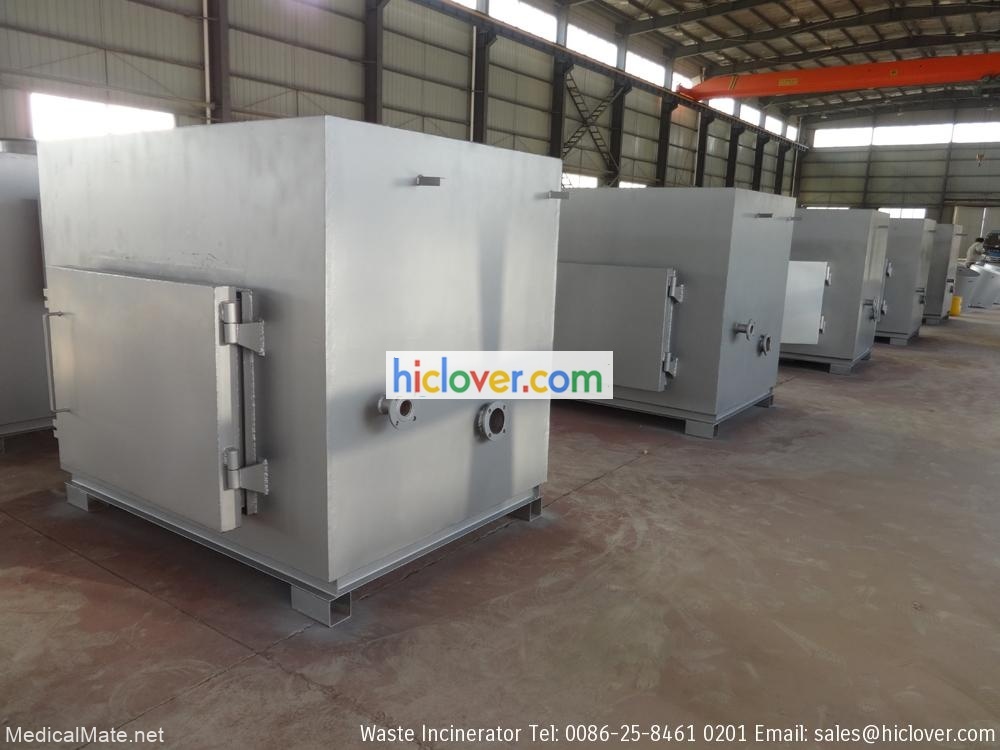
Incinerator Main Combustion Chamber

HICLOVER now offer a full range of containerized incineration systems, placing us at the forefront of the latest transportation and industrial 
trends. Containerization enables immediate waste management as the units are pre-assembled and pre-installed.
Containerization is the most feasible and viable option in contrast to the construction of on-site facilities and housing structures, 
eliminating the man power and costs involved. The system has the added benefit of total mobility (both local and international), and is ideal 
for military and civil camps and remote locations where infrastructure is scarce.
Incineration is the most obvious solution for total destruction of municipal waste, avoiding all the direct and indirect risks associated with 
other disposal methods.
Incineration perfectly fits into a trend of treating waste in a safe way, and if possible, at the same place where it was generated to avoid 
cross-contamination risk and to keep waste treatment costs at acceptable level.

WWW.HICLOVER.COM|Waste Incinerators |Auto Roll Air Filters

Nanjing Clover Medical Technology Co.,Ltd..

Central Australia’s Creature graveyard

The figure has been shown from the Alice Springs regional waste management facility report for October.

The dead pet you asked the vet to dispose of will wind up buried in landfill, in most places across the nation, and Alice Springs is not any different.

“it is a combo of horses, dogs, cats, pigs, any animal that dies,” explained Alice Springs council technical services manager Greg Buxton. “Road kill, kangaroos and that, the rangers select up them, and you’ve got to dispose of them someplace sterile. We place them at the back of landfill.”

The facility is on track to surpass last year’s total, with 3.7 tonnes deposited at the first quarter of the year.

Mr Buxton said most regional councils across the nation dispose of dead animals in garbage.

“In the bigger cities they have an incinerator type setting where they cremate themwhereas we don’t have an incinerator here,” he explained.

by: http://www.news.com.au/national/northern-territory/central-australias-animal-graveyard/story-fnn3gfdo-1227123002725